Why Saying No Feels So Scary: Your Nervous System Explained
Your heart pounds. Your throat tightens. Your face gets hot. All because someone asked you to do something and you want to say no. If saying no feels physically scary, your nervous system is doing exactly what it learned to do. Your body is treating a simple no like a threat to your safety, and understanding why is the first step to changing it.
Why Does Saying No Feel So Scary?
Your nervous system has one main job: keep you alive and connected. For humans, being connected to the group has always been a survival issue. Long ago, being rejected by your people could genuinely mean you would not make it.
So your body tracks belonging very closely. When saying no feels like it might cost you love, approval, or a relationship, your system sounds the alarm. The racing heart, the shaky voice, the urge to take it back are all signs of a body trying to protect you.
For many women, this alarm is set extra sensitive because of what they learned growing up.
The fawn response
Most people know about fight, flight, and freeze. There is a fourth survival response called fawn. Fawning means seeking safety by pleasing, agreeing, and keeping others calm.
If you grew up in a home where someone's mood ruled the room, or where love felt conditional on being good, your body may have learned that fawning works. Agreeing kept you safe. Being easy kept the peace. That learning gets stored in the body, and it runs automatically decades later in a meeting, at a family dinner, or in a marriage.
Your Body Knows Before Your Mind Does
I spent 15 years in public education as a teacher and school counselor, and I watched children's bodies carry their worries every single day. Stomachaches. Headaches. A child who could not walk into the cafeteria.
One mom, a teacher at the school, came to me after months of trying everything for her kindergartner. His stomach hurt every day. They had been to the pediatrician, read books about worry, prayed, reassured him. Nothing helped. After I talked with him, he ate lunch in the cafeteria that same day with no stomachache, and he asked for seconds at dinner. His worry had been living in his body the whole time. When it found somewhere to go, the body let go.
Adults are the same. We just get better at ignoring the signals. Before your mind admits that something is wrong, your body will tell you. It shows up as:
- Chest tightness on Sunday nights
- Fatigue that no amount of sleep fixes
- Irritability with people you love
- A clenched jaw or tight shoulders
- Crying at unexpected moments and not knowing why
A lot of what we call burnout is unspoken resentment. A lot of what we call anxiety is a body trying to leave a room it has been told to stay in.
Why Willpower Alone Does Not Work
You can know, intellectually, that you are allowed to say no. You can read every boundary book. And your body may still flood with panic when you try. That is because these patterns live in the older, faster parts of the brain that handle emotion, memory, and body sensation. They came online before language did.
Your thinking mind is brilliant. It is also slower than your survival wiring. That is why lasting change has to include the body.
How to Calm Your Nervous System When You Need to Say No
These are simple practices I teach clients to use in real time.
Slow your exhale
Breathe in for a count of four and out for a count of six or eight. A longer exhale signals safety to your nervous system. Do three rounds before you answer a request.
Buy yourself time
Your survival response peaks in the first few seconds. A pause lets it settle. Keep one phrase ready: "Let me check and get back to you." Then answer once your body has calmed.
Feel your feet
Press your feet into the floor and notice the ground holding you. This pulls your attention out of the spinning thoughts and into the present moment, where you are actually safe.
Check in with your body's yes and no
Before deciding, notice your body. A true yes often feels open and light. A fear-driven yes feels tight and rushed. Your body has never lied to you. It has been trying to get your attention for years. Treat its signals as data.
Practice tiny no's
Your nervous system learns from experience. Start with the smallest possible no. Decline an optional email. Return the wrong order. Each time you survive a no, your body updates its sense of what is safe.
Going Deeper: Healing the Root
Sometimes the fear runs deeper than in-the-moment tools can reach. You understand your pattern. You have done the therapy. And still, saying no feels like stepping off a cliff.
That is when body-based work becomes essential. In my practice, I use RIM, which stands for Regenerating Images in Memory. It is a facilitated, whole-brain process that works with how emotional memories are stored in the body. When the original fear softens at its source, saying no stops feeling dangerous. One client described her RIM session as so transformational that words could not describe it.
You Are Allowed to Say No
Your fear made sense once. It protected a younger version of you who needed protection. You can thank that part of you for keeping you safe, and you can also let her know she does not have to work so hard anymore.
Saying no will feel scary at first. Then it will feel uncomfortable. Then one day it will simply feel like telling the truth.
This article is educational content and is not medical or mental health treatment. If you are in crisis or need clinical care, please contact a licensed professional.
Common Questions About Fear of Saying No
Why do I panic when I say no?
Your nervous system may be treating a no as a threat to belonging and safety. This is especially common for people who learned early that agreeing kept them safe. The panic is a survival response, and it can be retrained.
What is the fawn response?
The fawn response is a survival strategy where the body seeks safety by pleasing, appeasing, and keeping others calm. It sits alongside fight, flight, and freeze, and it often underlies chronic people-pleasing.
How do I calm my nervous system before saying no?
Slow your breathing with a longer exhale, pause before answering, and ground yourself by feeling your feet on the floor. Practicing small no's in low-stakes moments teaches your body that saying no is safe.
Can body-based therapy help with people-pleasing?
Yes. Because people-pleasing patterns are stored in the body and older parts of the brain, body-based approaches such as RIM, breathwork, and somatic practices can create change where insight alone has stalled.
Ready to work at the root?
Coaching and RIM sessions help your body learn that saying no is safe.
Explore Coaching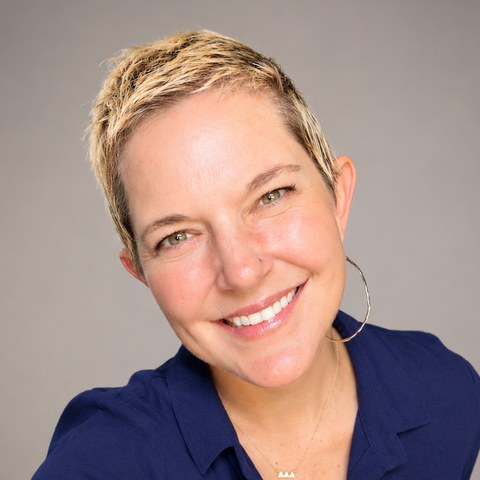
About Annie M. Henderson
Annie is a life coach, five-time author, podcast host of The Liberated Lesbian Lounge, and Expert Facilitator in RIM. She holds a BA in Psychology from Austin College and master's degrees in Education, School Counseling, and Professional Counseling. She spent 15 years in public education as a teacher and school counselor and was previously a Licensed Professional Counselor. She helps women break free from people-pleasing and build boundaries that hold, and shares this work with 118K+ followers on TikTok.
Annie is also the author of Later in Life Lesbian, Women with ADHD, Boundaries in Ink, The Liberation Year, and The Liberation Year Journal. Find her books on Amazon.